About
I want to feel.
What I actually do is fake it. And analyze it.
That's how I used to talk.
I grew up in a world where logic was the final argument. Then came the physics department. Whatever couldn't be measured and argued simply didn't exist for me. I thought it was cool, and I looked down on people whose lives bubbled with emotions. But gradually I started to feel that something was missing from life. Color, smell, intensity.
I started digging into it the only way I knew how. With my head. Thoroughly. At some point it seemed like I understood everything about myself. And nothing changed.
I went the usual route: dragging it out into the open, analyzing, working it through, learning to cope. It's pretty uncomfortable, and it only helps so much. Because instead of removing the cause, that kind of work tries to manage the symptoms.
But the cause didn't live in my head. It lived in the body.
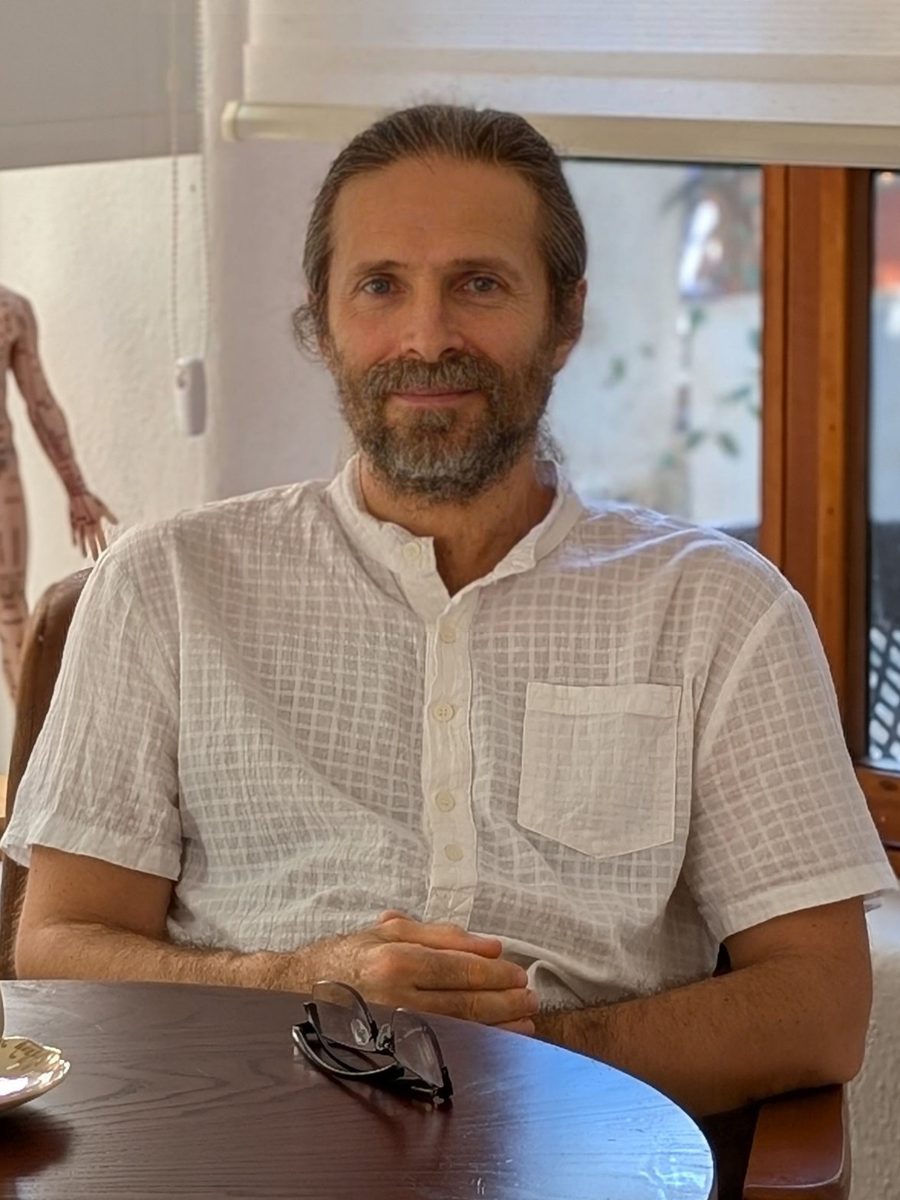
If this sounds familiar — hi. I'm a somatic therapist here in Playa del Carmen. And this is exactly what I can help with.
I work through the body, not only through conversation. The body gets tied up in knots for years, for so long that you've stopped noticing them. Sessions happen on the table, at your pace. Together we'll find those knots. And untie them.
The point of therapy is not for you to walk out of my office with a good feeling that's gone by dinner. It's for your past to stop running you, to stop shaping your reactions before you have time to think.
The first session is a diagnostic one. Nothing to prepare, no need to retell your whole life: the body says most of it anyway. People usually leave surprised by how much it had to say.
Where I Trained
People often ask me where I trained. Some of my teachers did issue certificates and diplomas. But I was never looking for teachers with impressive credentials. I was looking for those whose clients actually got better. Most of those masters never issued certificates, and none of them ever charged me for teaching. Each time, it took a long search to find a true master. And then I still had to persuade them to take me on as a student. So I won't list where or with whom I trained. Come to a diagnostic session, and I'll show you what I've learned.
Thirty Years, One Road
People came to me because they wanted to change. Early on, I tried to help the way many others do: to help them see things from a different angle, become aware, feel it through, and let it go.
But I always felt that the transformation my clients were striving for could go deeper. That's how working with the body came into my practice. At first I turned to classical Western bioenergetic analysis. It gave me precision: the muscular armor can be felt with the fingers, held breath can be heard, and the pattern is visible in the way a person stands and lies down. The hands learn to read the body like a book.
But this approach has its limits. It is precise, but not subtle enough. Many processes in the body slip past it. The answer came from Eastern medicine, the Chinese understanding of how energy moves through the body, and yogic techniques for working with energy. The full picture emerges not only from bodily patterns but also from deeper, subtler layers.
What My Method Is Based On
People have been working with the body and mind for a very long time, and they’ve learned a great deal. I don't work within any single tradition. In essence, they are all about the same thing; they just use different words.
My path is not about trying to invent something or give it a new name. It's about testing things in practice, year after year. Keeping what works. And letting go, without regret, of what only sounds good.
There were many teachers, in different countries; thirty years of practice turned out to be thirty years of apprenticeship.
The name of this method is not a trademark. Its essence is not a patent. People have spent centuries learning how to work with the body and passing that knowledge on from one generation to the next. Passed it on, not sold it. Giving a new name to what has long been known is foolish. Changing something just to make it yours is dishonest. Knowledge cannot be owned: by its nature, it belongs to everyone. It should stay that way. So everything written on this site is free to use. If you leave a link to the source, I'll be grateful.
How I Work
I don't have a protocol. Protocols are written so that you don't have to sense the person in front of you; they describe an average person, and in all my years of practice I have never met one. My work rests on three principles:
- observation
- your feedback
- checking what we both feel
Every technique I use must pass two tests: it has to be explainable, and it has to be felt. When the Chinese tradition speaks of an energy block, what the hands feel is anything but mystical: a dense, cold area that doesn’t breathe. I work with what the hands feel. And the final check is what you feel.
Why I Do This
I have never regretted the road I chose. At first, I saw every new client as a challenge. Over the years, I encounter fewer and fewer situations in my work that I haven't seen before. But I never stop marveling when a body that has held tension for years starts to function more naturally and the person begins to change: breathing deeper, standing taller, speaking in a different voice. And most importantly, they start to see the world differently, as a kinder, more interesting place, full of possibility. And without even noticing it, they begin to take for granted things they were recently arguing against. It is moments like these that give me the energy to keep going, and make me want to.
What I Don't Do
- I don't promise transformation in one session. Or even in three.
- I don't heal auras, don't tell your fortune from your posture, and don't tell you how to live your life.
- I'm not a substitute for a doctor.
I can't change the world around you. I won't try to turn you into a different person. Only you can do that. What I can do is help loosen the hold that past conditioning has on you.
Start with a Single Session
I don't ask you to believe in anything you can't feel for yourself. That's why the best answer to "who is this guy?" isn’t this page; it’s what you’ll feel and learn during a diagnostic session. To set that up, write to me, or just leave your contact details, and I'll get back to you myself.